TMTraumaMaster Academy

课堂学习 · 2026-10 更新Classroom learning · October 2026 update

开放性骨盆伤:MDT 病例复盘Open pelvic injury: MDT case debrief

真实病例材料经脱敏、泛化后改编。逐步辨认出血、脏器损伤和后续创面风险。Adapted from a de-identified, generalized real-case source. Identify bleeding, organ injury and later wound concerns in stages.

来源与审核记录Sources and review record
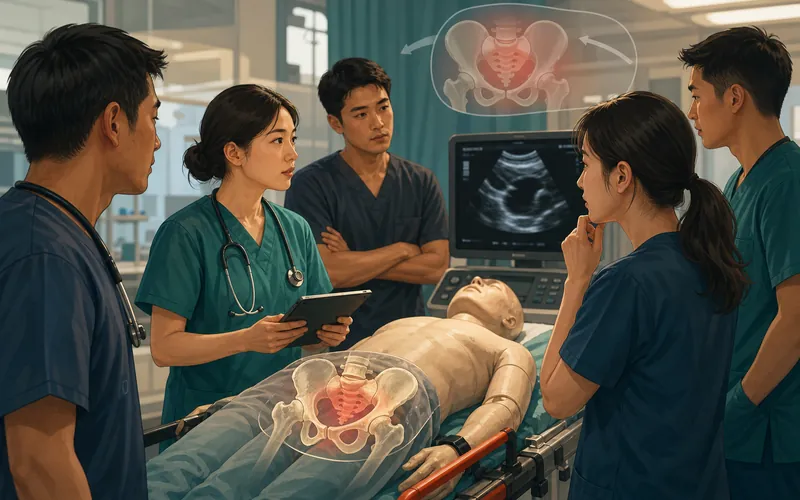
Conceptual teaching illustration, not case evidence
教学示意,非病例影像。Teaching illustration, not case imaging.

预计学习Estimated learning time · 30 分钟min

学完这门课,你能……After this course, you can…

  1. 描述开放性骨盆伤的出血、污染和脏器损伤风险。Describe bleeding, contamination and organ-injury risks in open pelvic injury.
  2. 为止血、结构稳定和脏器处理分配并行任务。Assign parallel hemorrhage-control, stabilization and organ-management tasks.
  3. 区分实际记录、教学提问和未提供的结局信息。Distinguish recorded care, teaching questions and unreported outcomes.
实习:识别与报告;规培:决策时机与监督下关键步骤;青年主治:团队指挥与资源调度。Intern: recognize/report; resident: decision timing and supervised key steps; early attending: team leadership and resources.
课前测 · 5 题Pretest · five questions

每题 1 分;用于形成性反馈。One point per item; formative feedback.

合成情境题Synthetic vignette 1. 32岁男性机械挤压后会阴开放伤,HR132次/min、BP86/54 mmHg、SpO₂92%。骨盆痛、敷料快速浸湿、皮肤湿冷;尚未完成直肠/泌尿道损伤评估,手术团队正在接收。下一步最合适的是?A 32-year-old man has an open perineal wound after machinery crush; HR 132/min, BP 86/54 mmHg, SpO₂ 92%. Pelvic pain, rapidly soaked dressings and clamminess coexist; rectal/urinary injury assessment is incomplete and surgery is receiving the patient. What is the most appropriate next step?
合成情境题Synthetic vignette 2. 32岁女性高能量撞击伴开放骨折,HR96次/min、BP118/72 mmHg、SpO₂97%。伤后25 min,伤口污染、骨外露;已并行控制外出血,未发现药物过敏,血培养尚未送检。下一步最合适的是?A 32-year-old woman has an open fracture after high-energy impact; HR 96/min, BP 118/72 mmHg, SpO₂ 97%. At 25 min after injury the contaminated wound exposes bone; external loss is controlled, allergy history is negative and cultures have not been obtained. What is the most appropriate next step?
3. 疑直肠伤评估?Assessment for suspected rectal injury?
4. 粪便转流适用于?When is fecal diversion used?
5. 未确认执行的治疗记录怎样写?How to write unconfirmed performed treatments?

教学改编:身份、精确年龄、日期、地点及资源数量已移除。只使用病例文字要点,原始 PPT 和影像未公开;未提供的信息保留未知。Teaching adaptation: identity, exact age, dates, location and resource quantities are omitted. Only clinical text is used; original slides and imaging are not public. Unreported information remains unknown.

四阶段逐步释放Four-stage information release

  1. 1/4 · 到院:先看生理Arrival: physiology first

    成人遭受高能量骨盆挤压伤,存在开放创口、盆部损伤和明显循环障碍;伴意识反应减弱、湿冷及心动过速。An adult sustains high-energy pelvic crush injury with an open wound, pelvic injury and marked circulatory compromise, accompanied by reduced responsiveness, cold skin and tachycardia.

    本轮问题Discussion prompt
    哪些是已知事实?除骨盆外,哪些失血来源和 xABCDE 风险仍未排除?What is known? Which other bleeding sources and xABCDE threats remain unresolved?

1/4
Conceptual teaching illustration
教学示意:用于理解任务与关系。Conceptual illustration of tasks and relationships.

01

防遗漏:围绕证据提问Prevent omissions by asking about evidence

  • 开放性骨盆伤同时考虑出血、污染、软组织和脏器损伤,避免只盯骨折。Consider bleeding, contamination, soft tissue and organ injury in an open pelvic injury, avoiding a fracture-only focus.
  • 检查报告、术中发现和术后引流信息持续合并;明确“不可靠”和“未检查”。Reconcile investigation, operative and later drainage findings; mark unreliable and unexamined assessments.
  • 这是一组预防遗漏的教学问题;材料不足以证明原病例实际发生漏诊。These are missed-injury prevention questions; the source does not establish that an actual missed injury occurred.
展开教学说明Teaching detail

材料记载早期 CT 检查,但未提供足够的检查前稳定程度、复苏反应与转运条件。本课不据此推断当时决策正确或错误,也不推广“休克患者先做 CT”。课堂应向原救治团队核对当时依据。The source records early CT but does not sufficiently establish pre-scan stability, resuscitation response or transfer conditions. The lesson neither judges that decision nor generalizes CT-first care in shock. The original team should clarify the context.

临床判断与关键步骤Clinical decisions and key steps

具体方案;以本院为准;每项数字同时核对人群、阶段和来源。Follow institutional protocols; check population, stage and source with every number.

开放骨盆:止血、污染与器官损伤Open pelvis: bleeding, contamination and organ injury

尽早抗生素与会阴评估Early antibiotics and perineal assessment

早期静脉抗生素,NICE开放骨折尽量伤后1 h内;会阴伤口保护、污染记录,疑直肠伤由受训者直肠指检,阳性行直肠镜。以本院规范为准。Early IV antibiotics; NICE open-fracture goal within one hour. Protect perineal wounds/document contamination; trained digital rectal assessment when rectal injury suspected, proctoscopy if positive. Follow institutional policy.

清创/填塞与血液复苏并行;直肠/泌尿伤评估后选择粪便转流或耻骨上膀胱造瘘,不是所有患者常规。以下是教学路径,未在原记录确认的措施不标作已实施。以本院规范为准。Debridement/packing and blood resuscitation proceed together. Fecal diversion or suprapubic drainage depends on rectal/urinary injury, not routine for everyone. Proposed teaching pathways are not documented performed care. Follow institutional policy.

原始生命体征、Hb/乳酸/BE不足,不生成看似真实的轨迹。另作模拟时须明确合成并与真实病例分离。以本院规范为准。Do not create a plausible real trajectory when original vitals/Hb/lactate/BE are missing. Any simulation must be distinctly synthetic. Follow institutional policy.

WSES骨盆2017WSES pelvic 2017 · NICE NG37NICE NG37 · 创伤失血性休克中国急诊专家共识(2023)Chinese emergency consensus on traumatic hemorrhagic shock (2023)

本土证据:从队列回到 MDT 问题Local evidence: from cohort to MDT questions

Ding 等,IJEM 2025:32 例多发伤合并骨盆骨折的单中心回顾性研究;报告死亡 3/32(9.4%),胸部合并伤 28/32(87.5%)。Ding et al., IJEM 2025: a single-center retrospective cohort of 32 polytrauma patients with pelvic fractures, reporting 3/32 deaths (9.4%) and 28/32 associated thoracic injuries (87.5%).

教学启示:同时看全身损伤、生理趋势和跨专科接续。方法报告单因素及相关性分析;不能据此证明 MDT 降低死亡,或把 GCS/ISS 解释为已验证的独立因果因素。Teaching implication: integrate whole-body injury, physiological trends and specialty transitions. Reported methods use univariate/correlation analysis; this does not prove that MDT reduces mortality or establish GCS/ISS as independent causal factors.

Clinical characteristics and mortality risk factors in polytrauma patients with pelvic fractures (2025)

单例教学材料与论文队列分别引用;未确认本病例是否属于该队列。The teaching case and publication cohort are cited separately; membership of this case in the cohort is unconfirmed.

依据与适用范围Sources and scope

课后测 · 5 题Posttest · five questions

每题 1 分;用于形成性反馈。One point per item; formative feedback.

合成情境题Synthetic vignette 1. 43岁男性机械挤压后会阴开放伤,HR144次/min、BP78/48 mmHg、SpO₂90%。骨盆痛、敷料快速浸湿、皮肤湿冷;尚未完成直肠/泌尿道损伤评估,手术团队正在接收。下一步最合适的是?A 43-year-old man has an open perineal wound after machinery crush; HR 144/min, BP 78/48 mmHg, SpO₂ 90%. Pelvic pain, rapidly soaked dressings and clamminess coexist; rectal/urinary injury assessment is incomplete and surgery is receiving the patient. What is the most appropriate next step?
合成情境题Synthetic vignette 2. 47岁女性高能量撞击伴开放骨折,HR102次/min、BP112/70 mmHg、SpO₂96%。伤后40 min,伤口污染、骨外露;已并行控制外出血,未发现药物过敏,血培养尚未送检。下一步最合适的是?A 47-year-old woman has an open fracture after high-energy impact; HR 102/min, BP 112/70 mmHg, SpO₂ 96%. At 40 min after injury the contaminated wound exposes bone; external loss is controlled, allergy history is negative and cultures have not been obtained. What is the most appropriate next step?
3. 开放骨盆疑直肠损伤,为什么不能只看皮肤口?Why is skin-wound size insufficient when rectal injury is suspected in an open pelvis?
4. 开放骨盆是否都要常规粪便转流?Does every open pelvic injury require routine fecal diversion?
5. 原材料未证实AE或转流已做,网页应如何表述?How should AE/diversion be described when original material does not confirm performance?