腹部脏器损伤与出血迷你模块Abdominal Injury and Bleeding Mini Module
聚焦机制、腹部体征、灌注趋势和 FAST/EFAST 信息节点。课程帮助学习者理解 C/E 的衔接,不写手术或介入选择算法。Focus on mechanism, abdominal findings, perfusion trend, and FAST/EFAST as information nodes. The course helps learners connect C/E without writing surgical or interventional choice algorithms.
source_required
预计学习Estimated learning time · 30 分钟min
学完这门课,你能……After this course, you can…
识别腹部/腹膜后隐匿损伤和持续出血担心。Recognize occult abdominal/retroperitoneal injury and bleeding concerns.
解释阴性 FAST 的边界及后续检查条件。Explain negative FAST limits and conditions for further investigation.
整合连续查体、灌注与止血资源讨论。Integrate serial examination, perfusion and hemorrhage-control planning.
实习:识别与报告;规培:决策时机与监督下关键步骤;青年主治:团队指挥与资源调度。Intern: recognize/report; resident: decision timing and supervised key steps; early attending: team leadership and resources.
腹部损伤:阴性FAST之后发生了什么?Abdominal injury: what follows a negative FAST?
数值曾经尚可,能否继续等待?An earlier acceptable snapshot: can we keep waiting?
沿用本课合成病例,非真实病历。逐条释放是学习节奏;临床立即威胁并行处理。选择不会改写患者生理。Retained synthetic teaching case, not a patient record. Release structures learning; immediate threats require parallel care. Choices never rewrite physiology.
主诉Presenting complaint
侧向撞击后左上腹痛,伴皮肤偏凉。Left upper abdominal pain after lateral impact, with cool skin.
现病史History
高能量侧向撞击,左上腹受力;伤后35分钟到院。抗凝药、既往疾病、过敏及进食时间待核实。High-energy lateral impact to the LUQ; arrival 35 minutes after injury. Verify anticoagulants, comorbidity, allergies and last meal.
院前交接Prehospital handoff
院前处理原病例未详记;核对外出血控制、氧疗、静脉通路、补液或血液、保暖和转运趋势。Prehospital treatment was not detailed; verify bleeding control, oxygen, access, fluids/blood, warmth and transport trends.
先核对初步查体与未知项Initial examination and unknowns
左上腹压痛,暂无明显反跳痛;骨盆稳定。Left-upper-quadrant tenderness without clear rebound; pelvis stable.
未提供的阴性体征不是已经排除;补问用药、氧疗及观察条件。An unreported negative finding is not an exclusion; verify medication, oxygen and observation context.
首组氧疗条件原记录未明确;GCS分项与体温为合成教学补充。Initial oxygen context was not recorded; GCS components and temperature are synthetic additions.
※为本轮合成教学补充,并非从真实病历追回的数据。氧疗条件是病例设定,不是推荐剂量;数值随预设观察时点变化,不由答题决定。※ marks synthetic teaching additions, not recovered patient records. Oxygen context is a case assumption, not a prescribed dose; preset observations change by time, never by quiz answer.
血糖/检验学习单:区分原值与教学补充Laboratory learning sheet: originals versus additions
到院Hb与乳酸2.2为教学补充;25分钟乳酸4.6沿用原病例。急性失血早期Hb可仍正常,不能据此排除出血。Arrival Hb and lactate 2.2 are teaching additions; +25 min lactate 4.6 is retained. An initially normal Hb does not exclude acute bleeding.
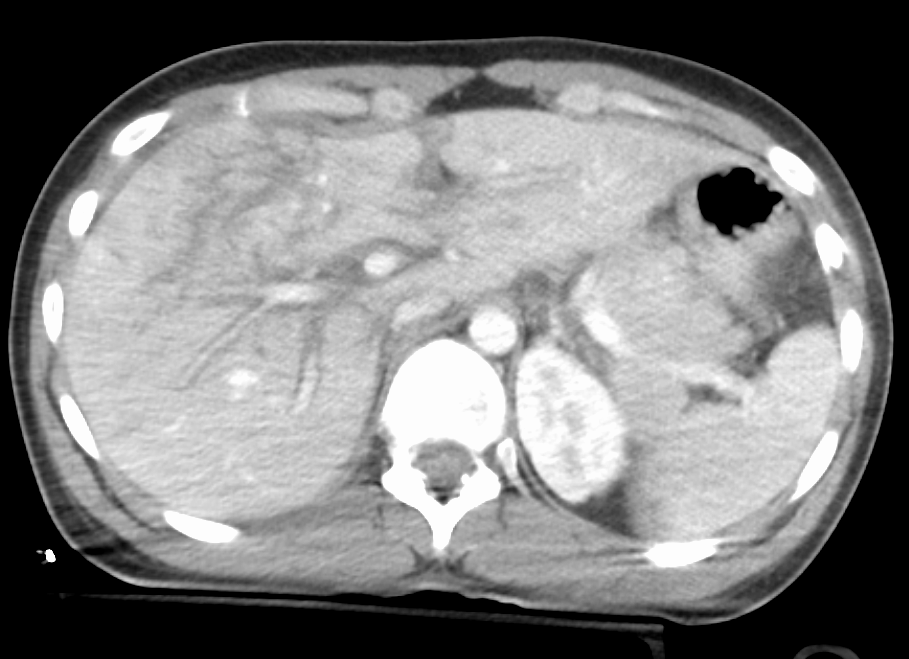
腹部 CT 定位,不替代持续灌注复评Abdominal CT localises injury but does not replace perfusion review
肝、脾影像来自不同外部病例;读形态之后,回到本课患者的趋势。The liver and spleen images are from different external cases. After reading morphology, return to the lesson patient’s trajectory.
在肝实质中寻找不规则低密度裂隙,结合完整影像评估伤情。原作者标注为 IV 级。Look for irregular low-density clefts in the liver and assess injury using the complete study. The source labels it grade IV.
这张图不能回答What this image cannot answer
单切片不能独立完成 AAST 分级、证明活动性出血或决定非手术治疗。One slice cannot independently establish the AAST grade, active bleeding or eligibility for nonoperative management.
保留原图;网页仅按比例显示。读图释义由课程另写,不是原作者诊疗结论。Original image retained and displayed proportionally. Teaching interpretation is separate from the original clinical conclusions.
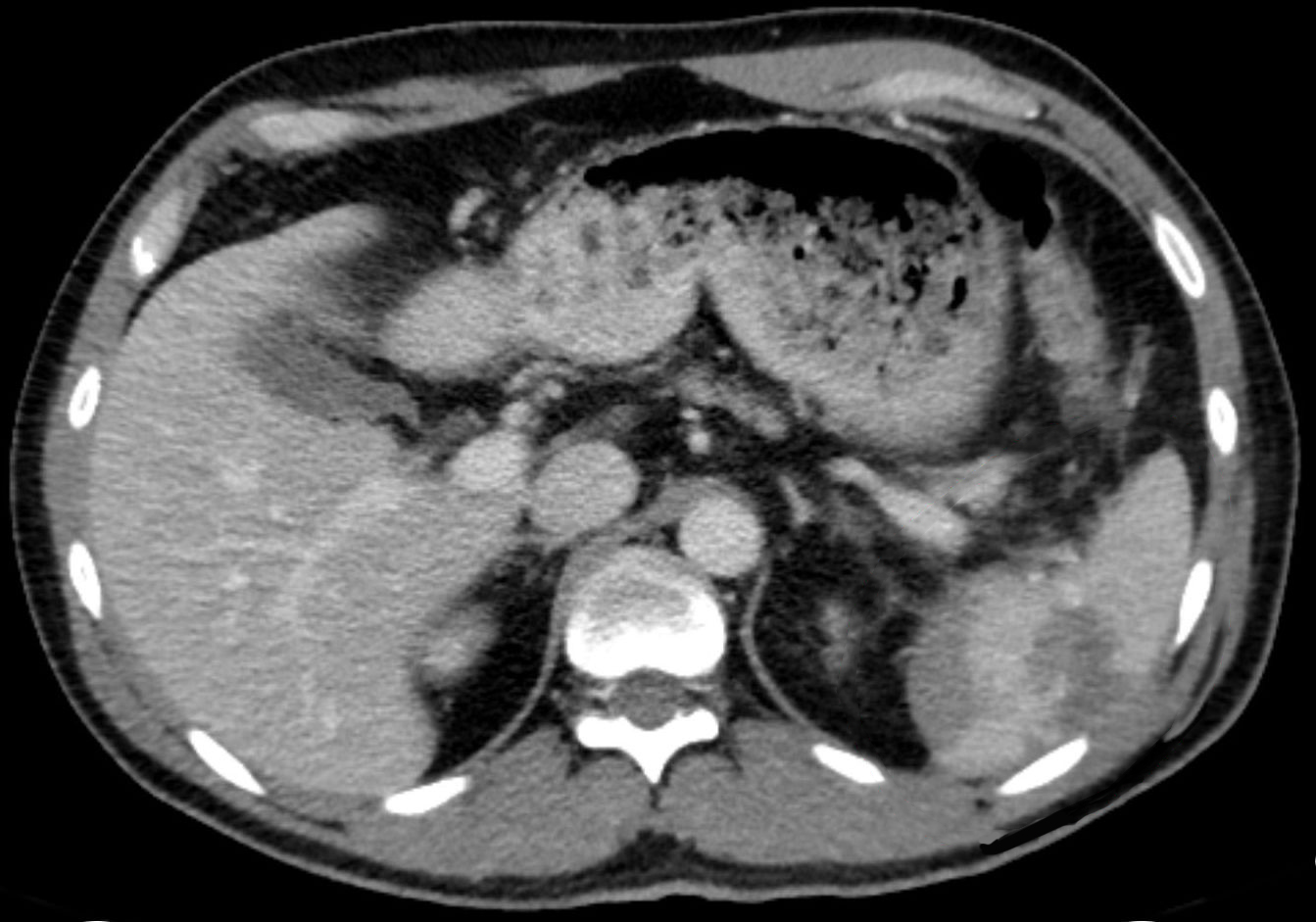
另一外部病例:脾损伤 CTA different external case: splenic injury CT
先看哪里Where to look
观察脾实质连续性及周围液体;把影像描述与患者灌注趋势分开记录。Inspect splenic continuity and surrounding fluid; record image findings separately from perfusion trends.
这张图不能回答What this image cannot answer
与肝图不是同一患者;单切片不能定量失血或证明观察方案安全。This is not the liver-image patient. One slice cannot quantify blood loss or establish that observation is safe.
Traumatic splenic rupture in computer tomography, axial. Portal venous contrast medium phase. Hypodense irregularity in the lower part of the spleen as a correlate of the parenchyma. Band-shaped hem at the lower edge as a sign of free fluid / blood. This is an edited version of the source image made
保留原图;网页仅按比例显示。读图释义由课程另写,不是原作者诊疗结论。Original image retained and displayed proportionally. Teaching interpretation is separate from the original clinical conclusions.
01
不能依赖阴性 eFAST 排除出血FAST answers a limited question
阴性 FAST 不能结束出血风险评估,也不能排除肠、系膜或腹膜后损伤。症状变化时重新查体和更新信息需求。Negative FAST does not close bleeding assessment or exclude bowel, mesenteric or retroperitoneal injury. Re-examine and update information needs as symptoms change.
阴性 ≠ 排除;eFAST不是增强CT的放行门槛。Negative ≠ excluded; eFAST is not the gatekeeper for contrast CT.
能安全检查且需要CT时,不为重复超声拖延;持续失稳无复苏反应时,最少必要影像用于指导紧急止血。When CT is indicated and safe, repeat ultrasound must not delay it; persistent instability without resuscitation response calls for only essential imaging to guide urgent haemostasis.
选择非手术路径需综合生理稳定、无其他需手术的损伤、连续监测及及时救援能力;不是凭影像分级单独决定。Nonoperative care requires physiologic stability, no other injury requiring surgery, serial monitoring and timely rescue capacity; imaging grade alone is insufficient.
03
新信息改变路径New information changes the pathway
腹痛范围、腹膜刺激征、灌注与实验室趋势恶化时,重新评估延迟显现的损伤;重复 CT 与介入或手术评估按病情和资源决定。Worsening pain, peritoneal findings, perfusion or laboratory trends prompt review for evolving injury; repeat CT and procedural assessment depend on physiology and resources.
暂停判断:阴性 FAST 与持续休克不一致,下一步关注什么?Pause and decide: Negative FAST conflicts with persistent shock. What next?
保留隐匿出血和其他休克机制,复评全身与重复信息;不能以阴性超声证明“没有出血”,也不能为检查延误危急患者的救治。Keep occult bleeding and other shock mechanisms in the differential, reassess the whole patient and obtain appropriate new information. Negative ultrasound neither proves no bleeding nor justifies delaying critical care.
真实公开图用于观察训练;病例与指南各自标明来源,病例报告不能单独建立普遍治疗规则。Public images support observation training. Case reports and guidelines are distinguished; a case report alone cannot establish a general treatment rule. Clinical applicability remains pending teacher review.
BEDSIDE → SPECIALIST → REASSESS
床旁救治与专科接续Bedside care and specialist continuity
每项措施都要回答:为什么做、由谁做、做后看什么。侵入操作由受训获授权人员执行,学员在监督下训练。For every action: why, who and what to reassess. Trained authorised operators perform invasive care; learners practise under supervision.
01
床旁:寻找并控制出血Bedside: find and control bleeding
快速xABCDE、通路、保暖、采血及血液准备并行;复苏反应与隐匿出血部位共同决定下一路径。Run xABCDE, access, warming, blood sampling and blood readiness in parallel; response and occult sources determine the next route.
02
失稳:手术/介入准备Instability: prepare haemostasis
持续不稳定或腹膜炎等需立即外科评估;只有生理和资源允许才进入CT,不能把“先CT”设为固定门槛。Persistent instability or peritonitis warrants urgent surgical assessment; CT requires appropriate physiology and resources, not a fixed prerequisite.
03
稳定:CT、观察或栓塞Stability: CT, observation or embolisation
肝脾非手术管理取决于稳定性、伴随损伤及救援能力;血管损伤讨论栓塞,肠道风险继续查体与选择性复查。Liver/spleen nonoperative care depends on stability, associated injury and rescue capacity; assess vascular injury for embolisation and bowel risk with serial examination and selected repeat imaging.
步骤、适用条件与复评核查Sequence, conditions and reassessment checks
确认主导威胁与当前生理,口头分派操作者和监护者。Confirm the dominant threat and current physiology; name operator and monitor.
按院内规程准备器材、通路、血液及专科资源;救命处置不等教学问答。Prepare equipment, access, blood and specialist resources under local protocol; rescue care never waits for teaching prompts.
由获授权团队实施所选措施;必要时结合技能页的专业步骤,不能用流程卡代替操作培训。Authorised teams deliver the selected intervention; linked skills supply procedure teaching, not certification by a flow card.
立即比较操作前后氧合、灌注与意识,记录时间、氧疗、药物及失败信号。Immediately compare oxygenation, perfusion and consciousness and record time, oxygen, drugs and failure signals.
没有改善时重新寻找未解决机制,升级专科或替代路径,明确下一复评责任人。If response is inadequate, reassess mechanisms and escalate specialists or fallback pathways with a named next owner.
来源、版本与教学解释Sources, versions and teaching interpretation
2026-10-04核对公开原始资料;标注文件实际年份,不统称“2026最新”。本页为教学整理,不复制官方算法;新增内容待临床教师终审。Public primary sources checked 2026-10-04; document years are shown rather than labelled “latest 2026”. This is teaching synthesis, not a copied official algorithm. New content awaits clinical teacher review.
独立教学轨迹:以下趋势不属于上方病例,不可拼接成同一患者时序。严重低氧需要同时评估气道、胸部及其他原因。Separate teaching trajectory: these observations are not the case above and must not be joined into one patient timeline. Severe hypoxaemia requires parallel assessment of airway, chest and other causes.
C/E 与 EFAST 信息节点总览图C/E and EFAST Information Overview
把机制、腹部线索、灌注趋势和床旁超声信息放到同一条路线里。Place mechanism, abdominal cues, perfusion trend, and bedside ultrasound information on one route.
visual_asset_pending_review
01 · MECHANISM机制进入风险图Mechanism enters the risk map先描述能量、方向和受伤后的时间线,不直接跳到脏器名称。Describe energy, direction, and timeline before jumping to an organ label.
02 · EXAM腹部与体表线索Abdominal and visible cues把外观、疼痛表达、压痛、膨隆和未检查区域转成可报告事实。Turn appearance, pain, tenderness, distension, and unexamined areas into reportable facts.
03 · PHYSIOLOGY监护趋势是否一致Does physiology fit?比较前后生命体征,判断生理严重度是否被当前解剖解释覆盖。Compare serial vital signs and ask whether the anatomic explanation covers physiologic severity.
04 · INFO NODEEFAST 后仍要复评Reassess after EFAST检查结果、床边表现与资源能力共同更新隐匿出血假设。Test information, bedside findings, and resources update the occult-bleeding hypothesis together.
教学监护趋势 · 前后比较Teaching monitor trend · serial comparison
HR86 → 105上升rising
BP67/46 → 58/36下降falling
RR26 → 33上升rising
SpO₂85 → 81下降falling
综合输出:一句问题表征 + 尚未解释的信息 + 下一次患者与资源复评。Output: one problem representation + unresolved information + next patient and resource reassessment.
01描述事实Describe facts
02对比变化Compare changes
03明确复评Plan reassessment
观察线索Observation cues
机制与腹部表现必须和生命体征趋势放在同一时间轴,而不是只看一张静态图片。Mechanism and abdominal findings belong on the same timeline as vital-sign trends, not in one static snapshot.
source_required
01描述事实Describe facts
02对比变化Compare changes
03明确复评Plan reassessment
检查节点Test node
床旁超声回答有限问题;结果必须回到床边表现、趋势和未知项。Bedside ultrasound answers a limited question; its result returns to findings, trend, and unknowns.
把实质脏器出血、空腔脏器损伤和腹膜后/骨盆来源放在同一鉴别地图中,避免把一次 FAST 结果当作终点。Keep solid-organ bleeding, hollow-viscus injury, and retroperitoneal/pelvic sources on one differential map; do not treat one FAST result as the endpoint.
WSES 指南结构WSES-guided structure
教材式核心Textbook core钝性减速、方向盘/安全带压迫、挤压和穿透伤造成不同损伤谱。早期腹部可以外观平静;意识障碍、脊髓损伤、镇静或分散性疼痛还会降低查体敏感性。因此,机制、连续腹部查体、灌注指标、血红蛋白/乳酸趋势和影像必须共同解释。Blunt deceleration, steering-wheel or seat-belt compression, crush, and penetrating mechanisms create different injury patterns. The abdomen may look quiet early, and altered consciousness, spinal injury, sedation, or distracting pain can reduce examination sensitivity. Mechanism, serial examination, perfusion, hemoglobin/lactate trends, and imaging must be interpreted together.
动态查体Dynamic examination
比较疼痛部位、压痛范围、肌紧张/反跳、膨隆、腹壁瘀斑和肩部牵涉痛是否出现或扩大;记录“本次较上次”的变化。Compare pain location, tenderness extent, guarding/rebound, distension, abdominal-wall bruising, and referred shoulder pain; document change from the previous exam.
影像讨论Imaging discussion
FAST/EFAST 主要寻找特定腔隙液体,阴性不能排除空腔脏器、胰腺、腹膜后或早期少量出血;稳定患者的增强 CT 用于损伤定位、分级和活动性出血线索。FAST/EFAST chiefly detects fluid in selected spaces; a negative study does not exclude bowel, pancreas, retroperitoneal, or small early bleeding. In stable patients, contrast CT localizes and grades injury and identifies active-bleeding clues.
处置路径Management pathway
先按 xABCDE 支持灌注并寻找出血源;是否进入非手术观察、介入或手术路径取决于血流动力学、腹膜炎体征、CT 特征、合并伤和机构即时资源。非手术管理必须包含连续查体、实验室与升级能力。Support perfusion and locate bleeding within xABCDE. Nonoperative observation, interventional, or operative pathways depend on hemodynamics, peritoneal signs, CT features, associated injuries, and immediate resources. Nonoperative care requires serial examination, laboratory follow-up, and rescue capability.
医生想法 1Clinician thought 1
“当前生理严重度能否被已经看到的腹部损伤解释?”“Does the identified abdominal injury explain the current physiologic severity?”
医生想法 2Clinician thought 2
“FAST 阴性后,哪些解剖区域和损伤类型仍没有被回答?”“After a negative FAST, which regions and injury types remain unanswered?”
医生想法 3Clinician thought 3
“下一次复评由谁完成,比较哪几个指标,恶化时资源是否已经就位?”“Who owns the next reassessment, which variables are compared, and are rescue resources ready if the patient worsens?”
按“机制—腹部表现—灌注趋势”收集可见事实,并明确尚未检查或无法解释的部分。Collect facts across mechanism, abdominal findings, and perfusion trend, naming what remains unexamined or unexplained.
学习产出:3 条事实 + 1 个未知Output: 3 facts + 1 unknown
02报告语言Report
用一句话分开描述伤情、当前生理变化和担心,不把检查或诊断名称写成结论。In one sentence, separate injury, current physiology, and concern without turning a test or label into the conclusion.
学习产出:一句问题表征Output: one problem representation
03信息节点Integrate
FAST/EFAST、床旁影像和 CT/CTA 只回答部分问题;说明它新增了什么、仍缺什么。FAST/EFAST, bedside imaging, and CT/CTA answer partial questions; state what each adds and leaves unresolved.
学习产出:新增信息 + 剩余未知Output: new information + remaining unknown
04复评与升级Reassess
重新比较患者趋势和系统资源,明确当前主导风险、责任人和下一次更新时间点。Recompare patient trend and system resources, naming dominant risk, owner, and next update point.
学习产出:下一次复评问题Output: next reassessment question
CASE 005
教学病例:腹腔脏器损伤与持续失血Teaching case: abdominal injury and ongoing hemorrhage
把两组生命体征、隐匿出血风险和资源时间轴带入完整病例复盘。Carry serial vital signs, occult-bleeding risk, and resource timeline into a full case debrief.
连续查体、FAST/EFAST 的信息边界、增强 CT 与分层处置框架已按 WSES 肠道损伤、肝损伤和脾损伤文件核对;具体本地资源路径仍需院内审核。Serial examination, FAST/EFAST limits, contrast CT, and stratified management were checked against WSES bowel, liver, and splenic guidance; local resource pathways still require institutional review.
指南已核对 · 本地流程待确认Guidelines checked · local workflow pending
临床判断与关键步骤Clinical decisions and key steps
具体方案;以本院为准;每项数字同时核对人群、阶段和来源。Follow institutional protocols; check population, stage and source with every number.
FAST阳性后,先问复苏反应Positive FAST: ask about resuscitation response
不稳定:不去CTUnstable: no CT detour
SBP<90 mmHg伴休克征,或维持压力需持续补液/输血/血管活性药:按不稳定路径评估。FAST阳性且对复苏无反应→直接手术/损伤控制止血;有反应且可安全监护才增强CT。以本院规范为准。SBP below 90 with shock signs, or pressure requiring ongoing fluids/blood/vasopressors, indicates instability. Positive FAST with no response goes directly to surgery/damage-control hemorrhage control; responders may have monitored contrast CT. Follow institutional policy.
BE应连同符号、乳酸与变化解释;不把WSES原文BE>−5单独当触发器,碱缺失BD与负BE不可混用。以本院规范为准。Interpret BE sign with lactate and trend; do not use the WSES printed BE greater than−5 as a stand-alone trigger or interchange BD with negative BE. Follow institutional policy.
NOM须稳定、连续监护/查体/Hb、有即刻手术、血液及介入能力;稳定者造影剂外溢可评估AE。脾切除/功能性无脾者安排肺炎球菌、脑膜炎球菌及Hib疫苗与感染教育,时点按专科。以本院规范为准。NOM needs stability, serial monitoring/exam/Hb, immediate surgery/blood and interventional capacity; stable contrast blush may prompt AE. Splenectomy/functional asplenia needs pneumococcal, meningococcal and Hib vaccination plus infection education on a specialist schedule. Follow institutional policy.