TMTraumaMaster Academy
MINI-MODULE · INTEGRATION

多发伤整合迷你模块Polytrauma Integration Mini Module

聚焦头胸腹骨盆组合中的优先级冲突、并行任务、资源升级和干预后复评。课程训练团队思维,不写单一专科路径。Focus on competing priorities, parallel tasks, resource escalation, and reassessment in combined head, chest, abdomen, and pelvic trauma. The course trains team reasoning, not a single-specialty pathway.

预计学习Estimated learning time · 35 分钟min

学完这门课,你能……After this course, you can…

  1. 同时描述解剖损伤、生理变化和任务优先级。Describe anatomy, physiology and task priority together.
  2. 避免用单一影像或伤区解释全部恶化。Avoid explaining all deterioration through one image or injury region.
  3. 在资源冲突中重新分工并复评措施反应。Reassign tasks and reassess response during resource conflicts.
实习:识别与报告;规培:决策时机与监督下关键步骤;青年主治:团队指挥与资源调度。Intern: recognize/report; resident: decision timing and supervised key steps; early attending: team leadership and resources.
课前测 · 5 题Pretest · five questions

每题 1 分;用于形成性反馈。One point per item; formative feedback.

合成情境题Synthetic vignette 1. 32岁男性高能量碰撞伴腹部压痛,HR132次/min、BP86/54 mmHg、SpO₂92%。四肢湿冷、伤口敷料再次浸湿,FAST尚未完成;团队以心率除以收缩压讨论失血风险。下一步最合适的是?A 32-year-old man has abdominal tenderness after a high-energy collision; HR 132/min, BP 86/54 mmHg, SpO₂ 92%. He is clammy with a re-soaked dressing and incomplete FAST; the team uses HR divided by SBP to assess bleeding risk. What is the most appropriate next step?
合成情境题Synthetic vignette 2. 32岁女性爆炸多发伤接受储氧面罩15 L/min,HR140次/min、BP78/48 mmHg、SpO₂87%。单侧胸廓起伏差、呼吸音消失,SpO₂仍低且循环差,床旁超声尚未完成,外出血控制也在进行。下一步最合适的是?A 32-year-old woman with blast polytrauma receives reservoir oxygen at 15 L/min; HR 140/min, BP 78/48 mmHg, SpO₂ 87%. Unilateral excursion/breath sounds are absent with persistent hypoxemia and poor circulation; ultrasound is incomplete and external bleeding control continues. What is the most appropriate next step?
3. 出血期Fib1.7 g/L说明?What does Fib1.7 g/L indicate during bleeding?
4. 致死四联征在三联征基础上加什么?What is added to the lethal triad for the diamond?
5. 无重型TBI的活动性出血早期SBP参考?Early SBP reference in bleeding without severe TBI?
CASE → OBSERVATION → ACTION → REASSESSMENT

多发伤:同时救治,持续重新排序Polytrauma: act together and reprioritise

低氧与低灌注同时恶化,谁负责下一步?Oxygenation and perfusion worsen together: who owns the next action?

沿用本课合成病例,非真实病历。逐条释放是学习节奏;临床立即威胁并行处理。选择不会改写患者生理。Retained synthetic teaching case, not a patient record. Release structures learning; immediate threats require parallel care. Choices never rewrite physiology.

主诉Presenting complaint
高速碰撞后多部位疼痛,伴呼吸和意识异常。Multisite pain after high-speed collision with abnormal breathing and consciousness.
现病史History
高速机动车碰撞,被困20分钟;头胸腹骨盆均可能受力。确切伤后时间、病史、抗凝及过敏待核实。High-speed collision with 20-minute entrapment; possible head, chest, abdominal and pelvic injury. Verify injury time, history, anticoagulants and allergies.
院前交接Prehospital handoff
核对脱困过程、颈椎保护、止血与固定、氧疗、用药和血液/补液记录;原病例未给出具体措施,不能虚构已做。Verify extrication, spinal precautions, bleeding control, splinting, oxygen, drugs and fluids/blood; specific prehospital actions were not supplied.
先核对初步查体与未知项Initial examination and unknowns

头面部擦伤、左胸呼吸音减弱、腹部压痛、骨盆风险及股骨畸形。Facial abrasions, reduced left breath sounds, abdominal tenderness, pelvic concern, and femoral deformity.

未提供的阴性体征不是已经排除;补问用药、氧疗及观察条件。An unreported negative finding is not an exclusion; verify medication, oxygen and observation context.

病例监护 · 到院0分钟Case observations · arrival 0 minSIMULATION
HR126/min
BP86/54mmHg
RR30/min
SpO₂90%
GCS13E3 V4 M6 ※
T35.4°C

首组氧疗条件原记录未明确;原GCS总分13保留,E3V4M6为本版教学设定。Initial oxygen context was not recorded; original GCS total 13 retained, E3V4M6 is a teaching assignment.

※为本轮合成教学补充,并非从真实病历追回的数据。氧疗条件是病例设定,不是推荐剂量;数值随预设观察时点变化,不由答题决定。※ marks synthetic teaching additions, not recovered patient records. Oxygen context is a case assumption, not a prescribed dose; preset observations change by time, never by quiz answer.

血糖/检验学习单:区分原值与教学补充Laboratory learning sheet: originals versus additions

到院采样的合成教学补充,非原记录、本页提供有来源的参考数字与关键步骤:实习识别与报告;规培在上级监督下执行;主治指挥与资源调度。剂量与阈值;以本院规范为准。用于讨论灌注、凝血与输血监测;不能等结果才开始救命处置。Synthetic arrival samples, not original records or treatment thresholds. Use to discuss perfusion, haemostasis and transfusion monitoring without delaying rescue care.

项目Test示例结果Example result
乳酸Lactate5.2 mmol/L
INRINR1.4
纤维蛋白原Fibrinogen1.7 g/L
离子钙Ionised calcium1.05 mmol/L
进入真实影像:不是本病例Read real images: separate patients
REAL SOURCES · READ → REASON → REASSESS

多发伤:把骨盆影像放回全身生理Polytrauma: place pelvic imaging within whole-patient physiology

这一窗口聚焦骨盆出血轴;胸、腹、颅脑和其他休克机制仍并行评估。This window focuses on the pelvic bleeding axis; chest, abdomen, brain and other shock mechanisms remain parallel concerns.

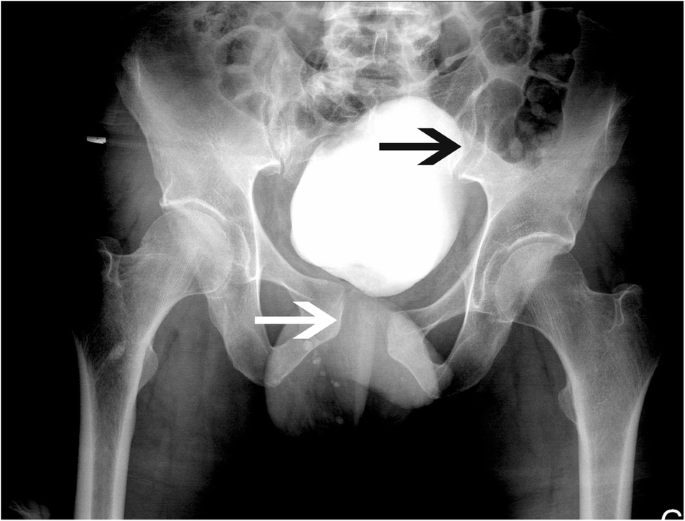
Jamme et al. 2018, Fig.5: pelvis after binder removal
Jamme 等 2018,Fig.5:束带移除后骨盆片Jamme et al. 2018, Fig.5: pelvis after binder removal

先看哪里Where to look

  • 白箭标示耻骨联合分离,黑箭标示左骶髂关节异常。作者病例提示束带可能掩盖损伤。The white arrow marks symphyseal separation; the black arrow marks left SI disruption. The published case illustrates masking by a binder.
这张图不能回答What this image cannot answer

不是本课合成病例;不能证明活动性出血。不能据此制定所有患者的束带移除流程。Not the lesson’s synthetic case; it does not establish active bleeding or a universal binder-removal protocol.

原始图注与许可Original caption and licence

Jamme S, Poletti A, Gamulin A, Rutschmann O, Andereggen E, Grosgurin O, Marti C · CC BY 4.0 · Original source / 原图出处

Pelvic anteroposterior plain film after binder removal showing pubic symphysis diastasis (white arrow) and left sacroiliac disruption (black arrow)

Figure 5 — Jamme S et al. False negative computed tomography scan due to pelvic binder in a patient with pelvic disruption: a case report and review of the literature. J Med Case Rep. 2018;12:271. DOI: 10.1186/s13256-018-1808-7 · Figure 5 — Jamme S et al. False negative computed tomography scan due to pelvic binder in a patient with pelvic disruption: a case report and review of the literature. J Med Case Rep. 2018;12:271. DOI: 10.1186/s13256-018-1808-7

Source · CC BY 4.0

保留原图;网页仅按比例显示。读图释义由课程另写,不是原作者诊疗结论。Original image retained and displayed proportionally. Teaching interpretation is separate from the original clinical conclusions.
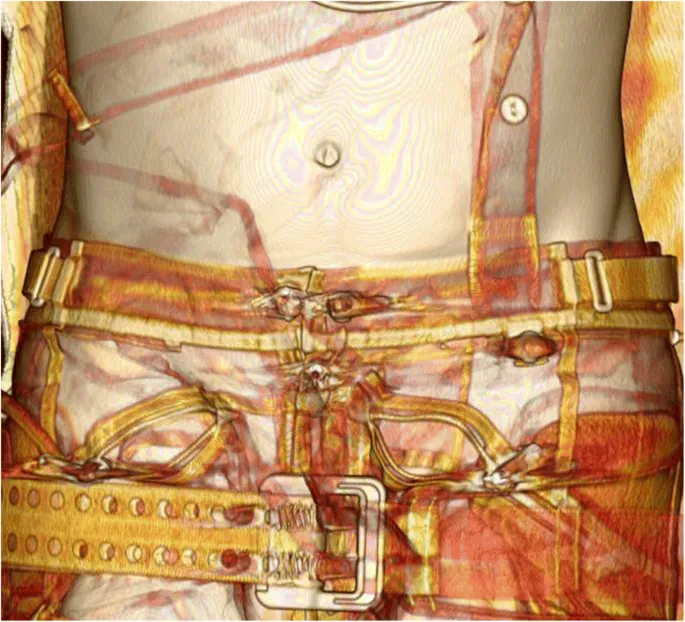
Same published case, Fig.1: CT reconstruction with binder in place
同一发表病例,Fig.1:束带在位 CT 重建Same published case, Fig.1: CT reconstruction with binder in place

先看哪里Where to look

  • 识别环绕骨盆的束带;该病例先有束带在位 CT,之后才拍摄上面的平片。Identify the circumferential binder. In this published case CT with the binder preceded the radiograph above.
这张图不能回答What this image cannot answer

3D 图不能替代完整 CT、床旁稳定性和灌注判断;影像表面复位不等于出血已控制。The 3D view cannot replace the full CT, bedside stability or perfusion assessment. Apparent reduction does not mean bleeding is controlled.

原始图注与许可Original caption and licence

Jamme S, Poletti A, Gamulin A, Rutschmann O, Andereggen E, Grosgurin O, Marti C · CC BY 4.0 · Original source / 原图出处

Computed tomography showing the pelvic binder (SAM® Pelvic Sling™ II) in situ

Figure 1 — 同上(Jamme S et al. J Med Case Rep. 2018;12:271) · Figure 1 — 同上(Jamme S et al. J Med Case Rep. 2018;12:271)

Source · CC BY 4.0

保留原图;网页仅按比例显示。读图释义由课程另写,不是原作者诊疗结论。Original image retained and displayed proportionally. Teaching interpretation is separate from the original clinical conclusions.

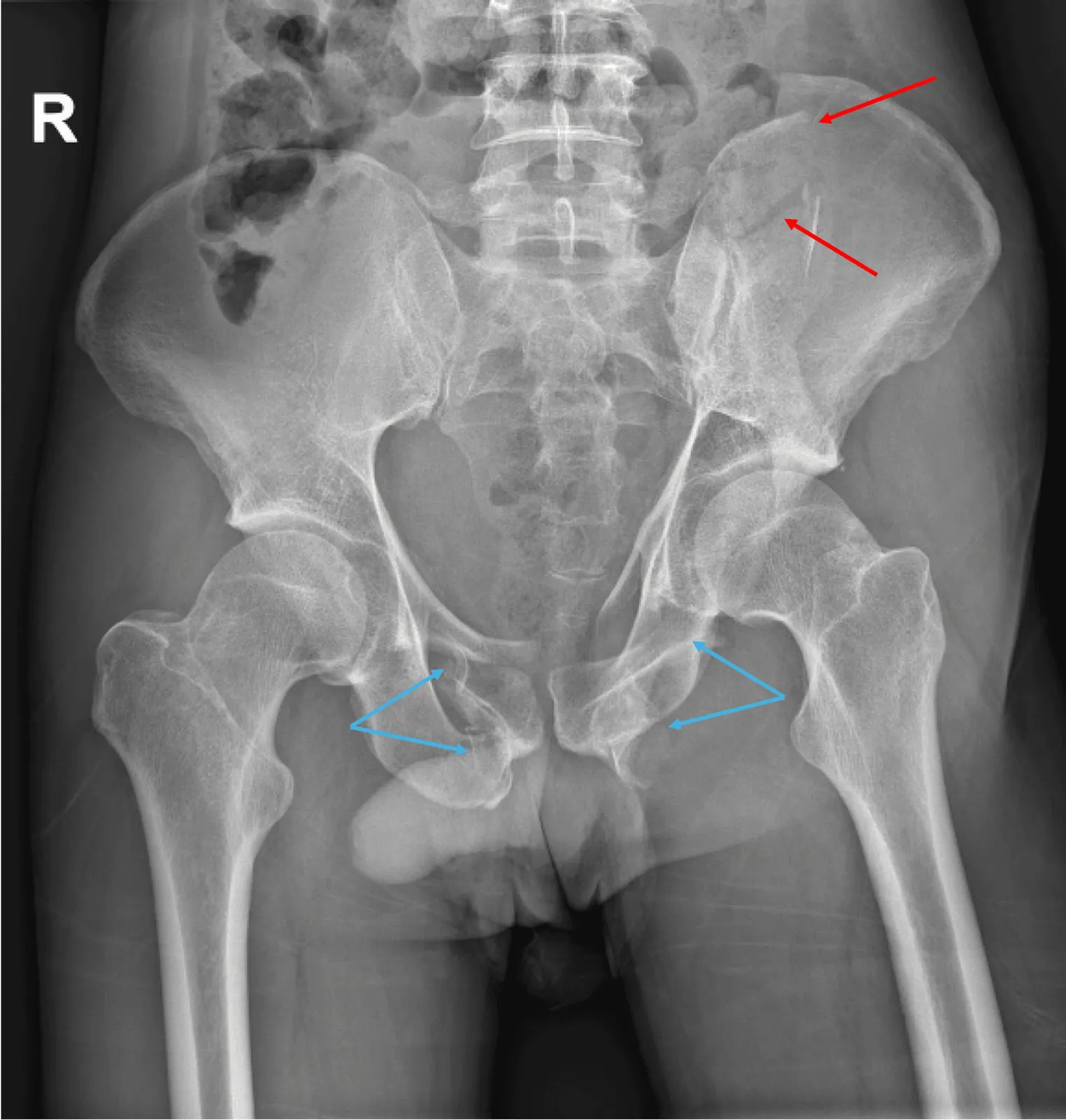
Leite-Moreira et al. 2026, Fig.1: complex pelvic ring injury
Leite-Moreira 等 2026,Fig.1:复杂骨盆环损伤Leite-Moreira et al. 2026, Fig.1: complex pelvic ring injury

先看哪里Where to look

  • 红箭为左侧髂骨新月形骨折,蓝箭为双侧耻坐骨支骨折;寻找前后环的组合损伤。Red arrows mark a left iliac crescent fracture; blue arrows mark bilateral ramus fractures. Inspect combined anterior and posterior ring injury.
这张图不能回答What this image cannot answer

LCIII 为原作者综合检查后的分类;不能仅凭这张正位片确定全部韧带损伤、垂直稳定性或休克原因。LCIII is the source author’s classification after full assessment. This AP image alone cannot establish all ligament injuries, vertical stability or the cause of shock.

原始图注与许可Original caption and licence

Leite-Moreira JP, Seixas J, Boavida J, Pais Lopes A · CC BY 4.0 · Original source / 原图出处

FIGURE 1: Preoperative anteroposterior pelvic radiograph. Red arrows indicate the left crescent iliac fracture. Blue arrows indicate the bilateral iliopubic and ischiopubic rami fractures.

Surgical Management of a Lateral Compression (LC)III Pelvic Ring Fracture With Type I Crescent Fracture-Dislocation: A Case Report · FIGURE 1

Source · CC BY 4.0

保留原图;网页仅按比例显示。读图释义由课程另写,不是原作者诊疗结论。Original image retained and displayed proportionally. Teaching interpretation is separate from the original clinical conclusions.

01

解剖与生理并列Keep anatomy and physiology together

损伤名称不等于当前休克原因;结合机制、连续灌注、全身出血来源和复苏反应更新风险。An injury label does not establish the current cause of shock. Update risk using mechanism, serial perfusion, all bleeding sources and response to resuscitation.

02

优先级可并行Priorities can run in parallel

出血控制、复苏、保温、凝血评估和资源启动相互衔接。不稳定且无反应的患者不应因 CT 延误必要的出血控制。Bleeding control, resuscitation, warming, coagulation assessment and resource activation are coordinated. CT should not delay necessary haemorrhage control in an unstable nonresponder.

03

颅脑损伤是重要例外Brain injury changes assumptions

不能把无脑损伤条件下的允许性低血压策略套用到重型 TBI。意识下降同时核对低氧、休克和药物等混杂因素,避免由 GCS 单独归因。Do not apply permissive hypotension intended for patients without brain injury to severe TBI. Assess hypoxia, shock and drug confounders when mentation falls; GCS alone does not establish cause.

暂停判断:束带后影像改善,能宣布出血停止吗?Pause and decide: Imaging improves with a binder. Can bleeding be declared controlled?

不能。复位形态和止血效果分别判断,继续追踪灌注、凝血和资源路径;束带移除或进一步影像由团队规划。No. Reduction and haemostasis are separate assessments. Continue perfusion/coagulation review and resource coordination; binder removal and further imaging require a team plan.

核对依据、版本与适用范围Check evidence, version and scope

真实公开图用于观察训练;病例与指南各自标明来源,病例报告不能单独建立普遍治疗规则。Public images support observation training. Case reports and guidelines are distinguished; a case report alone cannot establish a general treatment rule. Clinical applicability remains pending teacher review.

BEDSIDE → SPECIALIST → REASSESS

床旁救治与专科接续Bedside care and specialist continuity

每项措施都要回答:为什么做、由谁做、做后看什么。侵入操作由受训获授权人员执行,学员在监督下训练。For every action: why, who and what to reassess. Trained authorised operators perform invasive care; learners practise under supervision.

01

床旁:多条救命任务并行Bedside: parallel life-saving tasks

外出血控制、气道/氧合、胸部可逆威胁、出血复苏、保暖与监护同步分工;每项行动后回报生理反应。Assign bleeding control, airway/oxygenation, reversible chest threats, haemorrhage resuscitation, warming and monitoring in parallel; report physiologic response after each action.

02

止血与影像:按生理选择Haemostasis / imaging: choose by physiology

持续失稳优先可实施的止血路径;能安全完成才讨论全身CT。伴脑损伤不能直接套用允许性低血压。Persistent instability prioritises feasible haemostasis; discuss whole-body CT when safe. Do not apply permissive hypotension mechanically with brain injury.

03

多专科/重症:接续与遗漏伤Specialists / ICU: continuity and missed injuries

持续追踪灌注、凝血、体温与钙;专科协商源控制,稳定后三级查体、遗漏伤筛查和康复。Track perfusion, haemostasis, temperature and calcium; coordinate source control, then tertiary survey, missed injuries and rehabilitation after stabilisation.

SUSPECT → PROTECT → IMAGE SAFELY → REASSESS

本院早期协作原则:保护与定位并行Local early-care principle: protect and localise in parallel

依据您提供的本院规则制作的教学归纳;公开指南支持下面的适用边界,不等同于已核验的院内正式文件。具体流程由本院团队核准。Teaching synthesis of the local rule supplied by the clinician; public guidance supports the conditions below, not verification of a formal hospital document. Local teams approve implementation.

怀疑胸腹盆出血 → 尽早增强CTSuspected torso bleeding → early contrast CT

复苏后稳定或有反应、能安全转运时,尽早完成增强CT定位。CT不是等FAST阳性才做;重大多发伤由团队安排全身检查范围。When stable or responding to resuscitation and transport is safe, obtain early contrast CT. A positive FAST is not required; the team determines whole-body coverage for major multiple injury.

疑颈椎损伤 → 运动限制与合适颈托Suspected cervical injury → motion restriction and suitable collar

先维持手法轴线保护,评估气道后使用合适颈托并复核气道。气道受损、已知脊柱变形等需调整保护方式,不能强行矫正姿势。Maintain manual in-line protection, assess airway, fit an appropriate collar and recheck airway. Airway compromise or known spinal deformity requires an adapted approach, without forcing alignment.

疑骨盆环出血 → 选择性早期束带Suspected pelvic-ring bleeding → selective early binder

高能量钝性伤、疑骨盆环损伤并有出血担心时早期使用;中心位于大转子水平,由受训人员核查。稳定骨折或孤立髋臼骨折不因“骨盆骨折”标签一律使用。Use early for high-energy blunt injury with suspected pelvic-ring injury and bleeding concern, centred over the greater trochanters and checked by trained staff. Stable or isolated acetabular fractures do not automatically require a binder.

持续失稳、无复苏反应:先救命与止血,不为CT转运延误。Persistent instability without resuscitation response: prioritise rescue and haemostasis over CT transfer.

复评与依据:固定不等于已排除损伤Reassessment and evidence: protection does not exclude injury

束带是临时措施,需持续核对灌注、皮肤、神经血管及位置;束带在位可掩盖骨盆分离。撤除/更换由创伤与骨盆专科制定方案,不擅自松开。颈托后复核气道与神经状态。A binder is temporary; check perfusion, skin, neurovascular status and position. It can conceal pelvic diastasis. Removal or replacement requires a trauma/pelvic plan; do not release it independently. Recheck airway and neurology after collar placement.

步骤、适用条件与复评核查Sequence, conditions and reassessment checks
  1. 确认主导威胁与当前生理,口头分派操作者和监护者。Confirm the dominant threat and current physiology; name operator and monitor.
  2. 按院内规程准备器材、通路、血液及专科资源;救命处置不等教学问答。Prepare equipment, access, blood and specialist resources under local protocol; rescue care never waits for teaching prompts.
  3. 由获授权团队实施所选措施;必要时结合技能页的专业步骤,不能用流程卡代替操作培训。Authorised teams deliver the selected intervention; linked skills supply procedure teaching, not certification by a flow card.
  4. 立即比较操作前后氧合、灌注与意识,记录时间、氧疗、药物及失败信号。Immediately compare oxygenation, perfusion and consciousness and record time, oxygen, drugs and failure signals.
  5. 没有改善时重新寻找未解决机制,升级专科或替代路径,明确下一复评责任人。If response is inadequate, reassess mechanisms and escalate specialists or fallback pathways with a named next owner.
来源、版本与教学解释Sources, versions and teaching interpretation

2026-10-04核对公开原始资料;标注文件实际年份,不统称“2026最新”。本页为教学整理,不复制官方算法;新增内容待临床教师终审。Public primary sources checked 2026-10-04; document years are shown rather than labelled “latest 2026”. This is teaching synthesis, not a copied official algorithm. New content awaits clinical teacher review.

多发伤优先级冲突总览图Polytrauma Priority Conflict Overview

把头、胸、腹、骨盆风险放到一张团队复评图里。Place head, chest, abdomen, and pelvis risks into one team reassessment map.

visual_asset_pending_review
01 · CONFLICT先画多轴风险Map competing axes把 A/D、B、C、E 的异常同时放上桌面,不抢答唯一结论。Place A/D, B, C, and E abnormalities together before choosing one conclusion.
02 · PARALLEL拆分并行任务Separate parallel tasks患者观察、信息收集和资源准备由团队并行推进。Patient observation, information gathering, and resources move in parallel.
03 · SYNTHESIZE伤情与生理是否匹配Does injury match physiology?检查已见损伤能否解释全部生命体征和新查体线索。Ask whether visible injury explains all vital signs and new findings.
04 · REORDER重新识别主导风险Re-identify dominant risk每次新信息或团队行动后,都允许优先级重新排序。Allow priorities to reorder after every new finding or team action.
多轴趋势板Multi-axis trend board
A/DΔ意识/保护state
BSpO₂ ↓呼吸趋势breathing
CBP ↓灌注趋势perfusion
ENEW新查体线索new cue
01描述事实Describe facts
02对比变化Compare changes
03明确复评Plan reassessment
优先级冲突Priority conflict

先识别冲突,不抢答结论。Recognize conflict before rushing to conclusion.

01描述事实Describe facts
02对比变化Compare changes
03明确复评Plan reassessment
复评循环Reassessment loop

行动后重新回到 xABCDE。Return to xABCDE after action.

多发伤深化层:冲突优先级与并行处置Polytrauma Depth Layer: Competing Priorities and Parallel Care

从“逐项做完 xABCDE”升级为同时管理患者生理、解剖损伤、时间敏感资源和治疗之间的冲突。Move beyond completing xABCDE items in sequence to managing physiology, anatomy, time-sensitive resources, and treatment conflicts in parallel.

ATLS 11 · 创伤团队框架ATLS 11 · trauma-team frame
教材式核心Textbook core多发伤不是多个单病种的简单相加。胸部损伤会改变氧合和通气,失血会改变脑与肾灌注,颅脑损伤又会改变循环目标和查体可靠性;镇痛、镇静、搬运和影像等待也会改变观察结果。每项新信息都必须回到整体生理重新排序。Polytrauma is not a sum of isolated diagnoses. Chest injury changes oxygenation and ventilation; bleeding changes cerebral and renal perfusion; TBI changes circulatory goals and examination reliability; analgesia, sedation, transport, and imaging delays alter observations. Every new datum must return to whole-patient physiology and reprioritization.
三张同步地图Three synchronized maps

患者地图:xABCDE 与趋势;损伤地图:头胸腹骨盆脊柱四肢;资源地图:手术、介入、影像、血液、重症和转运状态。三图时间戳必须一致。Patient map: xABCDE and trends; injury map: head, chest, abdomen, pelvis, spine, limbs; resource map: operating, interventional, imaging, blood, critical care, and transfer status. Keep all three time-stamped.

并行而非混乱Parallel, not chaotic

每项任务写清“目的—责任人—预计更新时间—失败后的升级路径”。团队负责人保留全局视角,避免所有人围绕一个检查或一个部位工作。Every task states purpose, owner, expected update, and escalation if it fails. The team leader preserves the global view so the whole team does not cluster around one test or body region.

复评触发Reassessment triggers

生命体征变化、新查体、转运前后、镇静/镇痛后、操作后和新影像报告都触发一次简短全身复评,并重写当前主导风险。Vital-sign change, a new finding, transport, analgesia/sedation, procedures, and new imaging each trigger a concise whole-body reassessment and a rewritten dominant risk.

生理优先Physiology first

识别可立即致命并可逆的气道、呼吸、出血和循环问题;避免因等待完整诊断而延误团队支持。Identify immediately lethal and reversible airway, breathing, hemorrhage, and circulatory problems; do not delay team support while waiting for complete diagnosis.

止血与凝血Hemorrhage and coagulation

出血控制、保温、连续凝血评估和目标导向复苏属于同一条路径;具体血液制品与药物由机构大出血流程决定。Hemorrhage control, warming, repeated coagulation assessment, and goal-directed resuscitation belong on one pathway; products and medications follow the institutional major-hemorrhage protocol.

冲突协调Conflict coordination

当颅脑、胸部和出血目标冲突时,明确哪个风险当前主导、哪个可并行处理、何时重新讨论,并邀请相应专科共同决策。When TBI, thoracic, and hemorrhage goals conflict, name the dominant risk, parallelizable work, time for renewed discussion, and specialties needed for joint decisions.

四个学习窗口Four Learning Windows

01识别冲突Recognize conflict

列出同时存在的 A/D、B、C、E 异常和每条轴尚未解释的部分。List concurrent A/D, B, C, and E abnormalities and what remains unexplained on each axis.

产出:多轴风险清单Output: multi-axis risk list
02安排并行任务Parallelize

把患者观察、信息节点、资源准备和交接更新分配到同一时间轴。Place observation, information nodes, resources, and handoff updates on one timeline.

产出:任务—责任人—更新点Output: task, owner, update
03整合伤情与生理Synthesize

判断已见解剖损伤是否覆盖全部生命体征、皮肤和实验室趋势。Ask whether visible anatomy covers all vital, skin, and laboratory trends.

产出:匹配项 + 未解释项Output: matched + unexplained
04重新排序Reprioritize

新线索或团队行动后,重新声明主导风险和下一次全身复评。After a new cue or team action, restate dominant risk and next whole-body reassessment.

产出:新的优先级Output: revised priority
CASE
003
颈椎风险与髋关节脱位C-spine risk and hip dislocation

练习高能量机制、神经症状和髋部畸形之间的优先级冲突。Practice priority conflict across mechanism, neurologic symptoms, and hip deformity.

打开病例Open case
CASE
004
多发伤与休克再评估Polytrauma and shock reassessment

练习解剖损伤与生理严重度不完全匹配时如何重新打开休克机制。Practice reopening shock mechanisms when anatomy and physiology do not fully match.

打开病例Open case

来源与审核状态Sources and Review Status

临床判断与关键步骤Clinical decisions and key steps

具体方案;以本院为准;每项数字同时核对人群、阶段和来源。Follow institutional protocols; check population, stage and source with every number.

十分钟恶化:胸膜、止血与四联征Ten-minute decline: pleura, hemorrhage and lethal diamond

15 L/min储氧下仍SpO₂87%SpO₂ 87% despite15 L/min reservoir

教学新增EFAST:左胸膜无滑动、右侧有滑动、无明显心包液;结合左呼吸音减低、BP78/48,立即由受训团队减压/胸引并复评,不等CT。以本院规范为准。Synthetic EFAST addition: absent left pleural sliding, right sliding present, no clear pericardial fluid. With reduced left sounds and BP78/48, trained teams decompress/drain and reassess without CT delay. Follow institutional policy.

到院SI126/86≈1.47、ABC≥2:启动本院大量输血路径评估,血液与源控制同步。以本院规范为准。Arrival SI126/86 about 1.47, ABC at least 2: activate assessment for the institutional massive-transfusion pathway while controlling the source. Follow institutional policy.

低温、酸中毒、凝血、低钙一起看Temperature, acidosis, coagulation and calcium

大出血Fib≤1.5 g/L考虑补充;iCa欧洲1.1–1.3 mmol/L、国内≥1.00;已给Fib1.7/iCa1.05是复查点,不应冒充已达补充阈值。以本院规范为准。Major bleeding Fib at most1.5 g/L prompts replacement assessment; European iCa1.1–1.3 mmol/L, Chinese at least 1.00. Given Fib1.7/iCa1.05 prompt review, not false claims that every replacement threshold is crossed. Follow institutional policy.

无TBI出血期SBP80–90;重型TBI MAP≥80 mmHg,不能套允许性低压。保温、气体/乳酸/VEM复查;PaCO₂35–40 mmHg需与脑/肺状态匹配。以本院规范为准。Without TBI, bleeding-phase SBP 80–90; severe TBI MAP at least 80 mmHg excludes permissive hypotension. Warm and repeat gases/lactate/VEM; PaCO₂35–40 must fit brain/lung physiology. Follow institutional policy.

创伤失血性休克中国急诊专家共识(2023)Chinese emergency consensus on traumatic hemorrhagic shock (2023) · 欧洲创伤大出血指南第六版(2023)European major bleeding guideline, sixth edition (2023) · 中华医学会相关学组:重伤院前救治共识(2026)Chinese expert consensus on prehospital major trauma (2026) · WSES-AAST胸部2025WSES-AAST thoracic2025

课后测 · 5 题Posttest · five questions

每题 1 分;用于形成性反馈。One point per item; formative feedback.

合成情境题Synthetic vignette 1. 43岁男性高能量碰撞伴腹部压痛,HR144次/min、BP78/48 mmHg、SpO₂90%。四肢湿冷、伤口敷料再次浸湿,FAST尚未完成;团队以心率除以收缩压讨论失血风险。下一步最合适的是?A 43-year-old man has abdominal tenderness after a high-energy collision; HR 144/min, BP 78/48 mmHg, SpO₂ 90%. He is clammy with a re-soaked dressing and incomplete FAST; the team uses HR divided by SBP to assess bleeding risk. What is the most appropriate next step?
合成情境题Synthetic vignette 2. 45岁女性爆炸多发伤接受储氧面罩15 L/min,HR146次/min、BP76/46 mmHg、SpO₂85%。单侧胸廓起伏差、呼吸音消失,SpO₂仍低且循环差,床旁超声尚未完成,外出血控制也在进行。下一步最合适的是?A 45-year-old woman with blast polytrauma receives reservoir oxygen at 15 L/min; HR 146/min, BP 76/46 mmHg, SpO₂ 85%. Unilateral excursion/breath sounds are absent with persistent hypoxemia and poor circulation; ultrasound is incomplete and external bleeding control continues. What is the most appropriate next step?
3. Fib1.7 g/L伴持续出血时,应如何对照≤1.5阈值?How should fibrinogen 1.7 g/L during bleeding be compared with the ≤1.5 threshold?
4. 大出血致死四联征为何需持续测离子钙?Why is ionized calcium monitored in the lethal diamond of hemorrhage?
5. 无重型TBI且未止血的成人,低压复苏目标适用到何时?Until when does the adult low-pressure hemorrhage target apply without severe TBI?